
YouTube monetization requirements: the two thresholds, and what changes in February 2027
The exact Partner Program requirements from YouTube's own help pages, the watch hours that do not count, and the two changes arriving on 1 February 2027.
Published September 21, 2026
The short version
- There are two doors, not one. 500 subscribers, with 3 public uploads in 90 days and either 3,000 watch hours or 3 million Shorts views, unlocks memberships, Supers and Shopping. Ad revenue needs 1,000 subscribers with 4,000 watch hours in 12 months, or 10 million Shorts views in 90 days.
- From 1 February 2027, new applicants need double: 8,000 watch hours in 365 days, or 20 million Shorts views in 90 days. Channels already in the program keep their place.
- The change almost nobody mentions: from the same date, every partner needs 10 million qualified Shorts views over the last 90 days to share in Shorts ad and subscription revenue. Fall below it and you stay in the program, still paid on long-form.
- Only public long-form watch hours count. Shorts watched in the Shorts feed, unlisted, private and deleted videos, ad campaigns, and live streams not kept as a replay do not.
- Reaching the numbers is not acceptance. A review follows, typically about a month. A first rejection can be appealed within 21 days, or you reapply after 30 days, then 90 days after that.
Every article on this topic opens with the same line: 1,000 subscribers and 4,000 watch hours. It is correct today, and it is about a third of the picture.
It leaves out the lower door that opens at 500 subscribers, the list of watch hours that silently do not count, the review that follows, and the two changes YouTube announced on 10 August 2026 for 1 February 2027. One of those changes applies to channels that are already monetized, which is the part that gets lost.
Everything below comes from YouTube's help pages and its official blog, read in September 2026.
Two doors, not one
YouTube's Partner Program has two entry levels. The lower one pays you through your audience directly. The higher one adds a share of ad and Premium revenue.
| Fan funding and Shopping door | Ads and Premium door | |
|---|---|---|
| Subscribers | 500 | 1,000 |
| Long-form route | 3,000 qualified watch hours in 12 months, plus 3 public uploads in 90 days | 4,000 qualified watch hours in 12 months |
| Shorts route | 3 million qualified Shorts views in 90 days, plus 3 public uploads in 90 days | 10 million qualified Shorts views in 90 days |
| What it unlocks | Channel memberships, Super Chat and Super Stickers, Super Thanks, Jewels and gifts, Shopping | Adds a share of watch page ads, Shorts feed ads and YouTube Premium revenue |
Two details change how you read that table.
The 500 door does not exist everywhere. YouTube lists the countries and regions where the expanded program is available: 99 of them when we checked, including the United States, the United Kingdom, France, India and Brazil. Outside that list, only the 1,000 door applies.
The 500 door does not pay ad revenue. YouTube can still show ads on your videos, and its help page says so plainly: until you meet the higher criteria, you are not eligible for a share of that revenue.
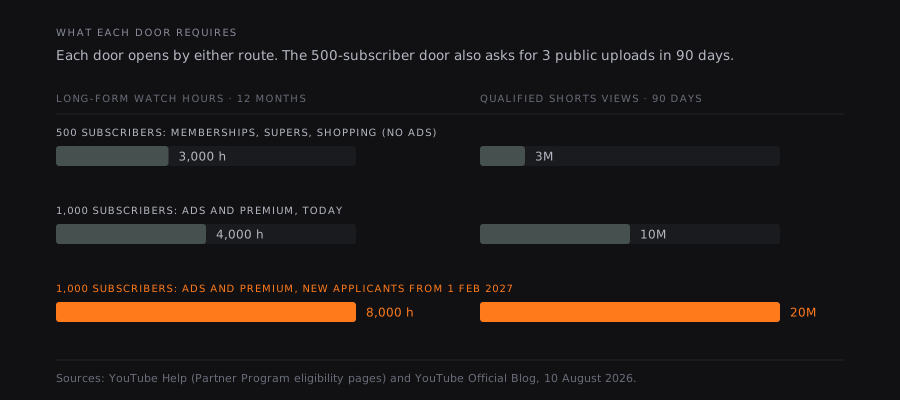
The 2027 bar is not a small adjustment. On the long-form route, a new applicant will need nearly three times the watch hours of the 500-subscriber door.
What changes on 1 February 2027
YouTube announced the changes on its official blog on 10 August 2026, and the Partner Program help page now opens on a banner about them.
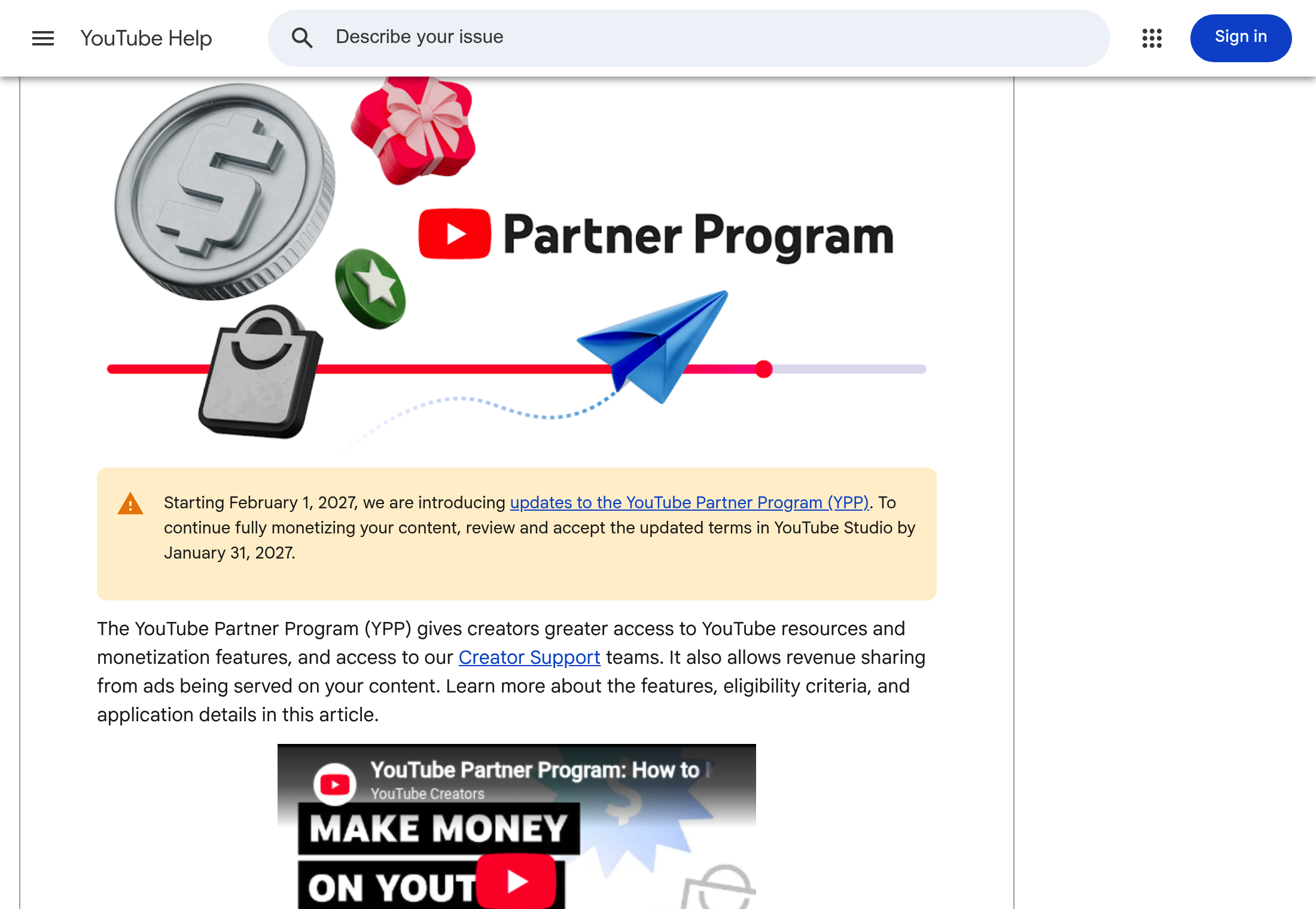
The banner sits at the top of the official eligibility page. Creators must review and accept the updated terms in YouTube Studio by 31 January 2027.
There are two separate changes, and they do not affect the same people.
Change 1: the ad door doubles for new applicants
New creators applying for the ads and Premium level will need 8,000 qualified watch hours in the last 365 days, or 20 million qualified Shorts views in the last 90 days. The 500-subscriber door does not move.
YouTube's wording on who is affected is unambiguous: "This update won't impact creators already in YPP."
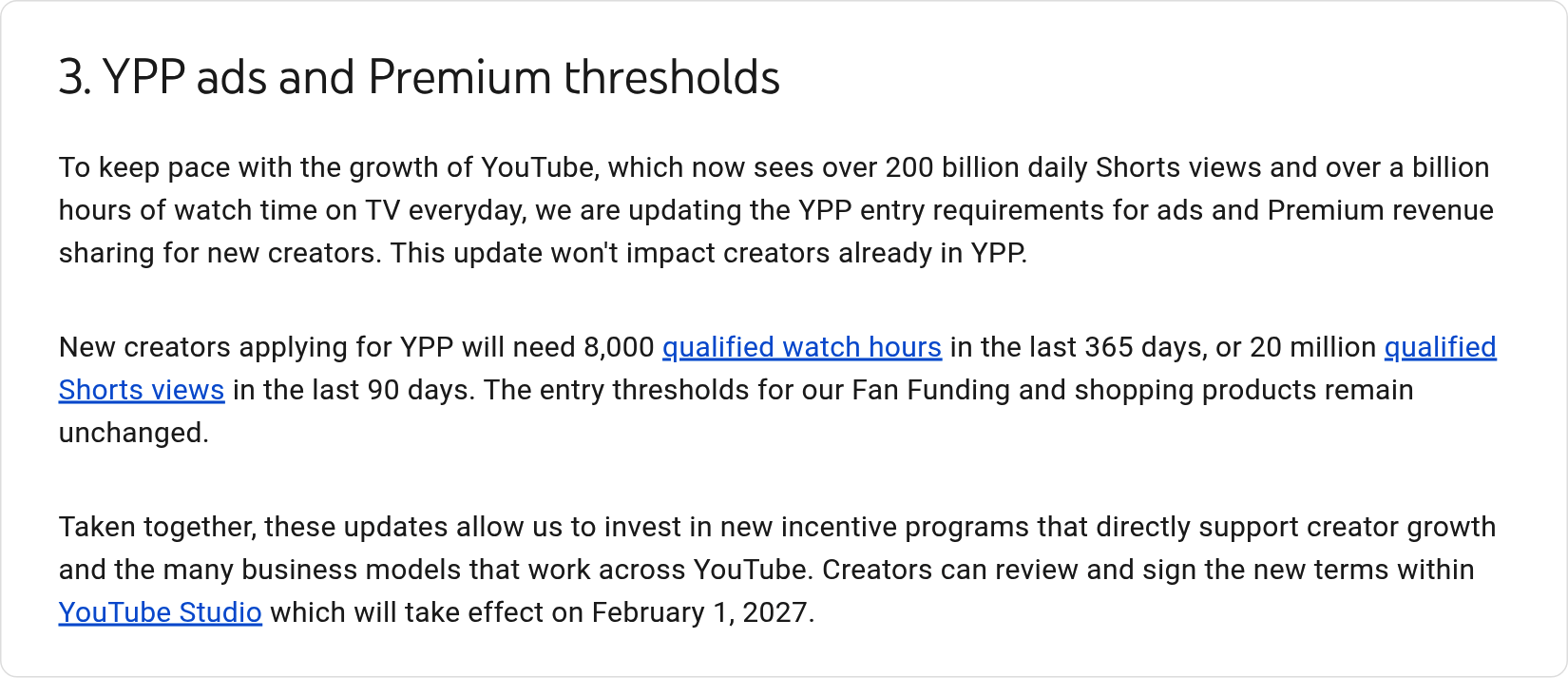
Section 3 of the official announcement. The new thresholds apply to creators applying from 1 February 2027.
Change 2: Shorts revenue gets its own threshold, for everyone
This is the part most summaries skip. From 1 February 2027, a channel needs 10 million qualified Shorts views over the last 90 days to share in ads and subscription revenue on Shorts. That condition applies to every partner, not just new ones.
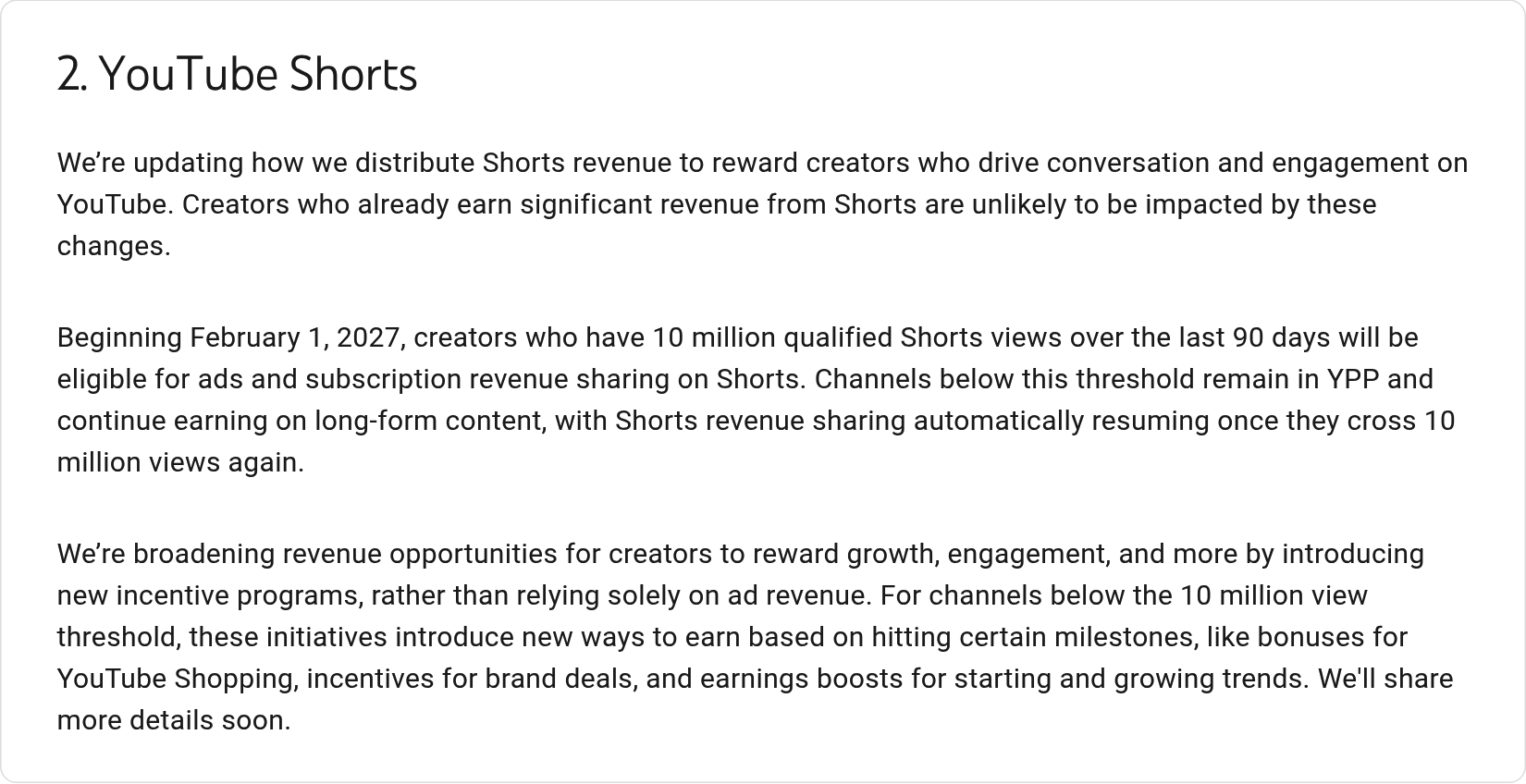
Section 2 of the same announcement. Below the threshold, a channel stays in the program and keeps earning on long-form.
YouTube softens it in three ways. A channel below the threshold stays in the program and keeps its long-form revenue. Shorts revenue sharing resumes automatically once the channel crosses 10 million views again. And YouTube says channels below the line will get new incentive programs instead, such as Shopping bonuses, brand deal incentives and boosts for starting trends.
What it has not published yet is how those incentives will pay. Its blog says only that more details will follow. We will not guess at amounts that do not exist.
If you run a mostly Shorts channel that earns a few dollars a month from the Shorts feed, this is the change that concerns you, and it has nothing to do with the new applicant thresholds.
What counts toward the thresholds
The word that does the work in every threshold is qualified. YouTube's help page defines it narrowly.
Watch hours count only from long-form videos you have set to public. These do not count:
- private, unlisted and deleted videos
- ad campaigns
- YouTube Shorts, including the watch time of Shorts viewed in the Shorts feed
- live streams that are unlisted, deleted, or not converted to a replay
Shorts views count only from public Shorts that appear in the Shorts feed. Private, unlisted and deleted Shorts, ad campaigns, and image posts in the Shorts feed are excluded.
The consequence people learn the hard way: a channel with millions of Shorts views can have almost no qualified watch hours, because the two routes never add up. You qualify through one or the other, never through a mix.
Our watch hours calculator works on exactly that distinction, and our monetization checker estimates how far any public channel is from the 1,000-subscriber and 4,000-hour marks. Both give estimates. The exact figures live in your YouTube Studio, the same way your exact subscriber count does.
The conditions that are not numbers
Hitting the thresholds is necessary, not sufficient. YouTube lists six other requirements:
- Follow the YouTube channel monetization policies.
- Live in a country or region where the Partner Program is available.
- Have no active Community Guidelines strikes on your channel.
- Turn on 2-Step Verification for your Google Account.
- Have access to advanced features on YouTube.
- Have one active AdSense for YouTube account linked to the channel, or set one up during the application. YouTube insists you create a new one only from YouTube Studio.
A strike does not close the door for good: you can apply once it expires, or after a successful appeal removes it.
After you apply
The application itself takes a few minutes: YouTube Studio, then Earn, then Apply now, accept the base terms, and link or create the AdSense for YouTube account. The status then shows In progress.
What follows is a review of the channel as a whole, by automated systems and human reviewers, against the monetization policies. YouTube's own estimate is about one month, with delays possible when volumes are high or when reviewers disagree about a channel.
Two facts reassure people who worry during the wait:
- If your numbers drop below the threshold after you apply, it does not matter. YouTube reviews the channel on the basis of the threshold you met when applying.
- Changing a video's privacy or deleting videos can affect the application, so this is not the moment to clean up your catalogue.
If the answer is no, YouTube offers two routes: appeal within 21 days, or keep publishing and reapply after 30 days. After a second rejection, or if you have already reapplied, the wait becomes 90 days. YouTube adds that a rejection usually means reviewers found a significant part of the channel outside its policies, so the fix is in the catalogue, not in the numbers.
Staying monetized
Getting in is not the end of it. YouTube lists three ways to lose monetization:
- Inactivity. YouTube may turn off monetization on a channel that has not uploaded a video or published a post for 6 months or more.
- Policy violations. A channel that breaks the monetization policies loses monetization regardless of its watch hours or subscriber count.
- Shorts from 2027. As covered above, falling below 10 million qualified Shorts views over 90 days switches off Shorts revenue sharing, without removing you from the program.
Community Guidelines strikes, on the other hand, do not remove existing members. They only block new applications.
Which door to aim for first
For a long-form channel, the numbers make the case on their own. The 500 door asks for 3,000 watch hours, three quarters of today's ad threshold and 37.5% of the 2027 one. For any new applicant after 1 February 2027, the gap between the two doors becomes the whole story.
And the lower door is not a consolation prize. YouTube's own data for 2024 shows that among partner channels earning five figures or more, over half made money from sources other than ads and Premium. We unpack that figure in how much YouTubers actually make.
Once the ad door opens, the question becomes what it is worth. There is no per-view rate, and the median measured RPM sits around $2.30 per 1,000 views, as we explain in how much YouTube pays per view. Our revenue calculator runs on those measured ranges rather than on advertiser CPMs.
The fastest way through either door is the same: find the formats that pull far above your channel's usual numbers and make more of them. That is the method in our channel growth strategy, and it is what our country rankings apply market by market.
FAQ
How many subscribers do you need to make money on YouTube?
500 subscribers for the first level of the Partner Program, which pays through memberships, Supers, gifts and Shopping, provided you also have 3 public uploads in 90 days and either 3,000 watch hours in 12 months or 3 million Shorts views in 90 days. Ad revenue needs 1,000 subscribers. The 500-subscriber level exists only in the 99 countries and regions YouTube lists.
How many watch hours do you need to be monetized?
4,000 qualified public watch hours in the last 12 months for ad revenue today, or 3,000 for the fan funding and Shopping level. From 1 February 2027, new applicants for ad revenue will need 8,000 watch hours in the last 365 days. Channels already in the program are not affected by that increase.
Do Shorts views count toward the 4,000 watch hours?
No. Watch time from Shorts viewed in the Shorts feed does not count toward the watch hours threshold. Shorts have their own route: 10 million qualified Shorts views in 90 days for the ad level, or 3 million for the lower level. The two routes cannot be combined.
Will I lose monetization on 1 February 2027?
Not your place in the program: YouTube states that the higher entry thresholds do not affect creators already in YPP. But from that date, sharing in Shorts ad and subscription revenue requires 10 million qualified Shorts views over the last 90 days for every channel. Below that, you keep your long-form revenue and Shorts revenue sharing resumes automatically once you cross the threshold again. You must also accept the updated terms in YouTube Studio by 31 January 2027.
How long does YouTube take to review a monetization application?
About one month, according to YouTube, with delays possible when application volumes are high or when reviewers disagree about a channel. A drop in your numbers during the review does not affect the outcome, but changing video privacy or deleting videos can.
Can I monetize if my channel has a Community Guidelines strike?
Not while the strike is active: you can apply once it expires, or after it is removed on appeal. Channels already in the program are not removed for receiving a strike, although violating the monetization policies can end monetization at any time.
Useful sources
- YouTube Partner Program overview and eligibility (YouTube Help), for the 1,000-subscriber thresholds, the definition of qualified watch hours and Shorts views, the six conditions, the review process, the 21, 30 and 90-day delays, and the 6-month inactivity rule.
- Overview of the expanded YouTube Partner Program (YouTube Help), for the 500-subscriber door, the features it unlocks, and the list of 99 countries and regions.
- New opportunities to earn and changes to the YouTube Partner Program (YouTube Official Blog, 10 August 2026), for the 8,000 hours and 20 million Shorts views thresholds, the 10 million Shorts views condition on Shorts revenue sharing, and the new incentive programs.
- How YouTube revenue sharing works (YouTube Help), for the 55% and 45% revenue shares.
The thresholds tell you when YouTube will start paying. They say nothing about which of your videos will get you there.
That is the question VideoTrends answers: it compares every video to the median of its own channel, so the format that breaks out shows up the day it does, on your channel or on anyone else's.