
How Much Does YouTube Pay Per View? (What the Official Rules Actually Say)
YouTube publishes no per-view rate, and the figures circulating online are mostly advertiser CPM dressed up as creator earnings. Here is what YouTube officially pays, what a measured sample of 300 channels earned per 1,000 views, and how to work out your own number.
Published September 11, 2026
TL;DR
- YouTube has no per-view rate. It officially pays 55% of net watch-page ad revenue on long-form, and 45% of the Creator Pool allocation on Shorts. Nothing in its terms promises an amount per view.
- The famous "$0.01 to $0.03 per view" has no traceable source. Neither does "$18 per 1,000 views", which is an advertiser CPM mistaken for creator earnings.
- In the best measured dataset available (300 channels, 3,595 channel-months), the median total RPM was $2.30 per 1,000 views, so roughly $0.0023 per view and about $2,300 per million.
- Only 53% of views carried an ad at the median in that sample. That single fact is why CPM multiplied by 55% overstates earnings.
- Your own RPM is the only number that describes your channel. Everything else is someone else's median.
Search "how much does YouTube pay per view" and you will get a number within the first line of every result. A cent a view. Two cents. Three. Eighteen dollars per thousand.
Ask where any of those figures come from and the trail goes cold. They are quoted from articles that quote other articles. YouTube itself has never published a per-view rate, for a reason that becomes obvious once you understand how the payment actually works.
This article separates what YouTube officially states from what has merely been repeated often enough to sound official.
YouTube does not pay per view, and never claimed to
The revenue share is published. The per-view rate is not, because there isn't one.
For ads on the watch page, YouTube states that creators receive 55% of net advertising revenue. The platform keeps 45%. For Shorts, the arrangement is different: feed ad revenue is pooled each month, music licensing costs are deducted, and what remains is allocated between creators according to their share of eligible engaged views. The creator then keeps 45% of their own allocation, per YouTube's Shorts monetization policy.
Note what that second rule does not say. Creators do not receive 45% of Shorts ad revenue. They receive 45% of a slice that has already been carved out of a pool. YouTube's own worked example makes the difference concrete: on $100,000 of feed ad revenue and 100 million engaged views, the Creator Pool comes to $90,000 after music costs, a creator with 1% of eligible views is allocated $900, and their 45% share produces $405.
Both percentages are fixed and published. Neither tells you what a view is worth, because the amount of advertising revenue attached to a given view is not fixed at all.
The one fact that breaks every per-view estimate
Here is what the round numbers leave out.
Not every view carries an ad. YouTube states this plainly in its ad revenue analytics documentation, and lists the reasons: the video may not be advertiser-friendly, no suitable advertiser may be bidding, the viewer may be targeted by nobody, they may have seen an ad recently, or they may be a Premium subscriber.
YouTube publishes no platform-wide figure for how often this happens. The best measurement available comes from AIR Media-Tech's 2026 study, which read analytics directly from 300 partner channels: the median channel served an ad on 53% of its views. By niche, the spread ran from 32% for Kids & Teens to 77% for Education & Science.
So on a typical channel, roughly half the views generate no advertising revenue whatsoever. Any calculation that assumes an ad on every view is out by a factor of two before it starts.
CPM and RPM are not the same thing, and the confusion is expensive
Most wrong numbers online come from mixing up two metrics that YouTube defines separately.
| What it measures | Whose money | Revenue share | |
|---|---|---|---|
| CPM | What advertisers pay per 1,000 ad impressions | The advertiser's spend | Before YouTube takes its cut |
| RPM | What the creator earned per 1,000 views | Your actual payout | After YouTube takes its cut |
Two differences matter, and YouTube spells out both.
CPM counts ad impressions. RPM counts all views, including the ones that never showed an ad. And RPM is calculated after the revenue share, while CPM is measured before it.
That is why "take the CPM and multiply by 55%" produces a number that is too high. The calculation gets the revenue share right and the denominator wrong: it silently assumes every view was monetised. On a channel serving ads to 53% of views, the resulting estimate is roughly double reality.
RPM also includes revenue that has nothing to do with advertising. Channel memberships, YouTube Premium watch time, Super Chat and Super Thanks all count toward it. A channel with a strong membership base can post an RPM that no CPM calculation would ever predict.
What creators actually earned per 1,000 views
Percentages are published. Payouts are not. For those, measurement is the only honest source.
AIR Media-Tech read RPM through the YouTube Analytics API for 300 monetised partner channels, covering 3,595 channel-months between May 2025 and May 2026, on channels ranging from 10,000 to 50 million subscribers.
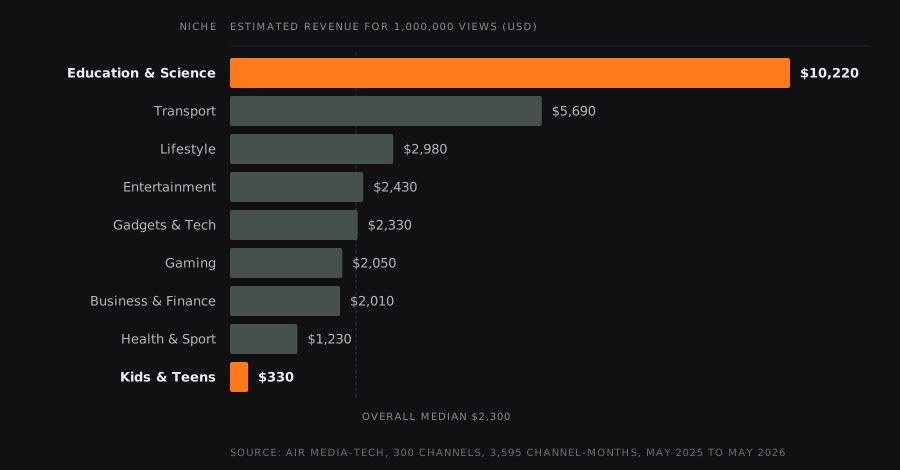 Median RPM per 1,000 views by niche. Source: AIR Media-Tech, 300 channels, 3,595 channel-months, May 2025 to May 2026.
The all-channel median was $2.30 per 1,000 views. That works out at about $0.0023 per view, or roughly $2,300 per million views.
| Niche | Median RPM |
|---|---|
| Education & Science | $10.22 |
| Transport | $5.69 |
| Lifestyle | $2.98 |
| News & Politics | $2.60 |
| Entertainment | $2.43 |
| Crafting & Handmade | $2.39 |
| Gadgets & Tech | $2.33 |
| Music | $2.28 |
| Food & Cooking | $2.25 |
| Gaming | $2.05 |
| Business & Finance | $2.01 |
| Health & Sport | $1.23 |
| Kids & Teens | $0.33 |
The limits, stated plainly: this is a sample of one company's partner channels, not a random draw across YouTube. It is not controlled for geography or format. Several categories (transport, news, food, business) contain fewer than ten channels each, so those lines are directional rather than settled. It remains the best publicly measured data available, which says something about the state of the subject.
Notice how far the top sits from the median. Education earns four times the typical channel. And notice where finance lands: eleventh, at $2.01, against the $15 to $30 that niche rankings routinely claim for it. That claim comes from advertiser CPM run through the 55% calculation, which is exactly the error above.
What that means for the numbers people actually search for
Taking the $2.30 median, and remembering that it describes a middle, not a promise:
| Views | At the $2.30 median | At $10.22 (Education) | At $0.33 (Kids) |
|---|---|---|---|
| 1,000 | $2.30 | $10.22 | $0.33 |
| 10,000 | $23 | $102 | $3.30 |
| 100,000 | $230 | $1,022 | $33 |
| 1,000,000 | $2,300 | $10,220 | $330 |
A million views is the figure everyone wants. On a median channel it is worth about $2,300. On an education channel it can exceed $10,000. On a kids' channel it can fall below $350.
Same platform. Same million views. A thirty-fold difference, driven by who is watching and what advertisers will pay to reach them. We take that milestone apart on its own, including how rarely videos get there, in how much YouTube pays for 1 million views.
This is why per-view figures are not just imprecise but actively misleading. There is no single number to be more accurate about.
Shorts pay differently, and considerably less
The Shorts revenue share is not merely a different percentage. It is a different mechanism, and the outcome is an order of magnitude apart.
AIR measured 274 channels across 3,044 channel-months and found Shorts RPM running at 3% to 14% of long-form RPM in nearly every niche, clustering between $0.07 and $0.20 per 1,000 views.
In practical terms: you need roughly 11,000 to 34,000 Shorts views to earn what 1,000 long-form views earn. Most non-music niches land between 11,000 and 26,000.
Music is the exception, at 41% to 60% of long-form RPM, because Content ID revenue enters the calculation. Roughly 1,100 Shorts views match 1,000 long-form views there. That exception does not generalise.
None of this makes Shorts worthless. They reach people who would never open a fifteen-minute video, and that audience can be moved toward long-form. But as a direct revenue source, judged per view, they are not comparable. The clearest illustration is MrBeast's own channel, where 9 billion Shorts views earn less than 1.8 billion long-form views at measured rates.
Before any of this applies: the eligibility thresholds
Views pay nothing at all until the channel is in the YouTube Partner Program. Two tiers exist, and they are frequently confused.
Ad revenue sharing requires 1,000 subscribers plus one of:
- 4,000 valid public watch hours in the previous 12 months, or
- 10 million valid public Shorts views in the previous 90 days
Shorts feed watch time does not count toward the 4,000 hours. That catches people out regularly.
From 1 February 2027 that bar doubles for new applicants: 8,000 watch hours, or 20 million Shorts views. Existing members are not removed for falling short of it, but everyone has to accept the new terms in YouTube Studio before 31 January 2027. The full picture is in how much YouTubers make. From the same date, sharing in Shorts revenue will also require 10 million qualified Shorts views over the last 90 days, for every partner, new or not. Both changes are broken down in YouTube monetization requirements.
The lower fan-funding tier (expanded YPP, available in eligible countries) requires 500 subscribers, 3 valid public uploads in the previous 90 days, plus either 3,000 valid public watch hours over 12 months or 3 million public Shorts views over 90 days. It unlocks memberships, Super Chat, Super Thanks and Shopping. It does not include ad revenue sharing.
Once earning, AdSense pays when the balance reaches the threshold, which is $100 for a dollar account, €70 in euros, £60 in sterling. Finalised earnings for the previous month land between the 7th and the 12th; if the threshold is met by the 20th, payment is issued between the 21st and the 26th.
The numbers to stop repeating
| Claim | Verdict |
|---|---|
| "YouTube pays $0.01 to $0.03 per view" | No traceable source. YouTube publishes no per-view rate and guarantees no earnings. |
| "$18 per 1,000 views" | Advertiser CPM mistaken for creator revenue. CPM is measured before the revenue share and counts only ad impressions. |
| "Multiply CPM by 55% to get RPM" | Wrong method. It assumes an ad on every view. The measured median is 53%. |
| "Shorts creators get 45% of Shorts ad revenue" | Misleading. They get 45% of their allocation from a pool, after music licensing costs. |
| "Finance is the highest-paying niche at $15 to $30 RPM" | Not supported by measurement. Finance ranked eleventh at $2.01 in the 300-channel sample. |
Work out your own number instead
Every figure above is a median drawn from other people's channels. Yours is in your own analytics, and it is the only one that describes your situation.
YouTube Studio shows it directly: Analytics, then Revenue, then RPM. It already accounts for your audience geography, your ad fill rate, your format mix and your non-advertising revenue. No published table can do that.
If you have no monetised channel yet, or you are sizing up a niche before entering it, our YouTube revenue calculator works from measured RPM rather than advertiser CPM, and shows the range rather than a single reassuring figure. To check whether you are close to the eligibility thresholds, the watch hours calculator and the monetization checker cover the two questions people ask most.
And there is a more useful question than "what does a view pay", which is: which of my videos are outperforming my own baseline, and why?
Revenue per view is largely set by your audience and your niche, neither of which changes quickly. The number of views is not. A video pulling five times its channel's median is showing you a format that works, and that multiple is measurable on any public channel, including ones that are not yours.
That method is set out in our guide to YouTube channel growth strategy, and the niche-by-niche earnings picture in the most profitable YouTube niches. What you can measure on a channel you do not own is covered in how to see YouTube analytics for other channels. If you are tracking the 1,000-subscriber threshold, note that the public count is not your real count. Our monthly rankings of top YouTube channels by country apply the same method market by market.
FAQ
How much does YouTube pay for 1,000 views?
There is no fixed rate. In the best measured dataset available (300 channels, 3,595 channel-months), the median was $2.30 per 1,000 views across all revenue sources. Education channels reached $10.22 and kids' channels $0.33. Your own RPM in YouTube Studio is the only figure that describes your channel.
How much does YouTube pay for 1 million views?
At the measured $2.30 median, roughly $2,300. The realistic range runs from about $330 on a kids' channel to over $10,000 on an education channel, because audience country and ad fill rate move earnings more than view count does.
Does YouTube pay per view or per ad?
Neither, strictly. YouTube pays a share of the advertising revenue actually generated, which is 55% of net watch-page ad revenue on long-form. Since only about half of views carry an ad at the median, a view with no ad on it generates no advertising revenue at all.
Why is my RPM lower than the figures published for my niche?
Most often audience geography and ad fill rate. Advertisers pay several times more to reach viewers in some countries than others, and the measured median for views that carried an ad was 53%, dropping to 32% in some niches. Published niche medians also hide wide spreads within each category.
How many subscribers do I need before views start paying?
1,000 subscribers plus either 4,000 valid public watch hours over 12 months or 10 million public Shorts views over 90 days, for ad revenue sharing. From 1 February 2027 that rises to 8,000 watch hours or 20 million Shorts views for new applicants. A lower tier at 500 subscribers unlocks memberships and Super Thanks in eligible countries, but not ad revenue, and that 500-subscriber bar is not changing.
Do YouTube Shorts pay the same as regular videos?
No. Measured across 274 channels, Shorts RPM runs at 3% to 14% of long-form, typically $0.07 to $0.20 per 1,000 views. Roughly 11,000 to 34,000 Shorts views earn what 1,000 long-form views earn. Creators keep 45% of their allocated Shorts pool against 55% of net long-form ad revenue.