
How much do YouTubers make? What the sources actually say
There is no average YouTuber salary, and the grids you see by subscriber tier come from nobody's data. Here is what YouTube publishes, what one measured study of 300 channels found, and why more than half of five-figure channels do not live on ads.
Published September 20, 2026
The short version
- YouTube publishes its revenue shares, never earnings. 55% on long-form ads, 45% of the allocated Shorts pool, 70% on memberships and Supers.
- Its own 2024 data: among Partner Program channels earning five figures or more, over half made money from sources other than ads and Premium.
- 67% of creators earn under $10,000 a year and just under 5% clear $100,000 (CreatorIQ, 5,095 creators surveyed). No average describes that shape.
- The bar doubles on 1 February 2027: 4,000 watch hours becomes 8,000, and 10 million Shorts views becomes 20 million. The 500-subscriber door does not move.
- Every "$X per 1,000 subscribers" grid you find is an estimate with no published method behind it. We looked.
Ask how much YouTubers make and you get a table. One thousand to ten thousand subscribers, so much a month. One hundred thousand, so much more. The numbers look precise, they are repeated everywhere, and almost none of them can be traced to anything.
We went looking for the sources. Here is what exists, what does not, and the one official figure that reframes the whole question.
The only numbers YouTube publishes are shares
This is the distinction that everything else rests on. YouTube documents what proportion it keeps. It has never published what a view pays.
| What you do | Your share | YouTube's wording |
|---|---|---|
| Ads on long-form videos | 55% | "55% of net revenues from ads displayed or streamed on their public videos" |
| Shorts | 45% | "45% of the revenue allocated to them based on their share of views from the Creator Pool" |
| Memberships, Super Chat, Super Stickers, Super Thanks | 70% | "70% of net revenues" |
The same page adds a sentence worth keeping in mind before trusting any estimate:
There are no guarantees under the YouTube partner agreement about how much or whether you'll be paid.
Two details that get lost in the retelling:
The 70% is not 70% of what your fan paid. It is calculated after taxes and fees are deducted, including App Store fees on iOS. The same $5 Super Thanks is worth less when it comes from an iPhone. YouTube currently covers credit card transaction costs.
Sales tax, VAT and GST are not revenue to Google and sit outside the share calculation entirely.
Why "per view" is the wrong unit
We covered the arithmetic in detail in how much YouTube pays per view, so here is the short version: taking an advertiser CPM and multiplying by 55% assumes every view carries an ad. At the measured median, 53% of views did. That single assumption roughly doubles the result.
That is why this article is organised around who earns what, not around a rate card.
What one study with a published method found
Most earnings tables cite nothing. One source we keep coming back to publishes its method: AIR Media-Tech, measuring 300 monetised channels across 3,595 channel-months, May 2025 to May 2026, through the YouTube Analytics API.
Its median RPM, all niches combined, is $2.30 per 1,000 views. By niche:
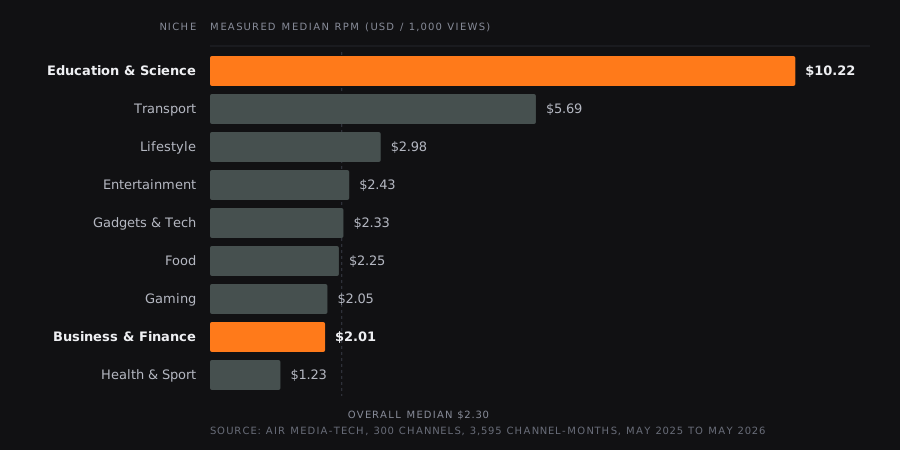
Education leads by a factor of five over gaming. The ordering surprises people who expect finance and tech at the top.
Note what this measures: revenue per 1,000 views on monetised channels, not a salary, not a total. A channel with a $10 RPM and 20,000 monthly views earns $200 a month from ads.
What no source publishes: earnings by subscriber tier
We looked specifically for a named study with a stated sample that gives revenue by subscriber count. We did not find one.
Every grid of the "1K-10K subscribers = $100 to $1,000 a month" kind that we checked traces back to a blog estimate with no method attached. The "average YouTuber salary" figures that circulate ($62,052, $99,550, $68,714) come from job-listing sites reporting what people declare, not from measured channel revenue, and they contradict each other by a factor of 1.6.
What does exist, with a method, is a distribution. CreatorIQ surveyed 5,095 creators across 100 regions in mid-2026, margin of error ±1.4 points:
67% of creators earn less than $10,000 a year. Just under 5% earn more than $100,000.
Two caveats we will not paper over: that survey covers creators across platforms, not YouTube alone, and it does not break results down by subscriber count. It tells you the shape of the distribution, not what a 50,000-subscriber channel makes.
That shape is the actual answer to "how much do YouTubers make". It is not a number, it is a long tail, and any single figure presented as typical is describing a minority.
The official figure that reframes everything
This one comes from YouTube's own internal data, January to December 2024, and it is the most useful sentence in the whole subject:
Among YouTube Partner Program channels that earned five figures or more in 2024, more than 50% generated revenue from sources other than ads and YouTube Premium.
Read that again. Among channels already earning seriously, the majority are not primarily living on the CPM that every article obsesses over.
YouTube names ten monetisation routes: ads, Premium, Shopping, BrandConnect, memberships, Super Chat, Super Stickers, Super Thanks, ticketing and gifts. Two of those, ticketing and gifts, are almost entirely absent from the articles ranking on this question.
For context, YouTube says it paid over $32 billion to partners in 2024 (attributed to a KPMG report, September 2025).
Two doors, not one
Most articles mention 1,000 subscribers and stop. There are two thresholds, and they unlock different economies.
The 500-subscriber door. 500 subscribers, 3 valid public uploads in the last 90 days, and 3,000 qualified watch hours, or 3 million Shorts views in 90 days. This unlocks memberships, Super Chat, Super Stickers, Super Thanks, gifts and Shopping features. It does not unlock ads.
The 1,000-subscriber door. 1,000 subscribers with 4,000 qualified watch hours over 12 months, or 1,000 subscribers with 10 million Shorts views over 90 days. This adds ad revenue sharing and YouTube Premium revenue.
A detail that costs people months: watch hours from Shorts in the Shorts feed do not count toward the 4,000 hours. Neither do private videos, unlisted videos, or live streams not converted to VOD. Our watch hours calculator works on that distinction, because it is the half of the threshold people underestimate.
The bar doubles on 1 February 2027
This is the newest fact in this article, and we have not seen it in any of the pages currently ranking on this question.
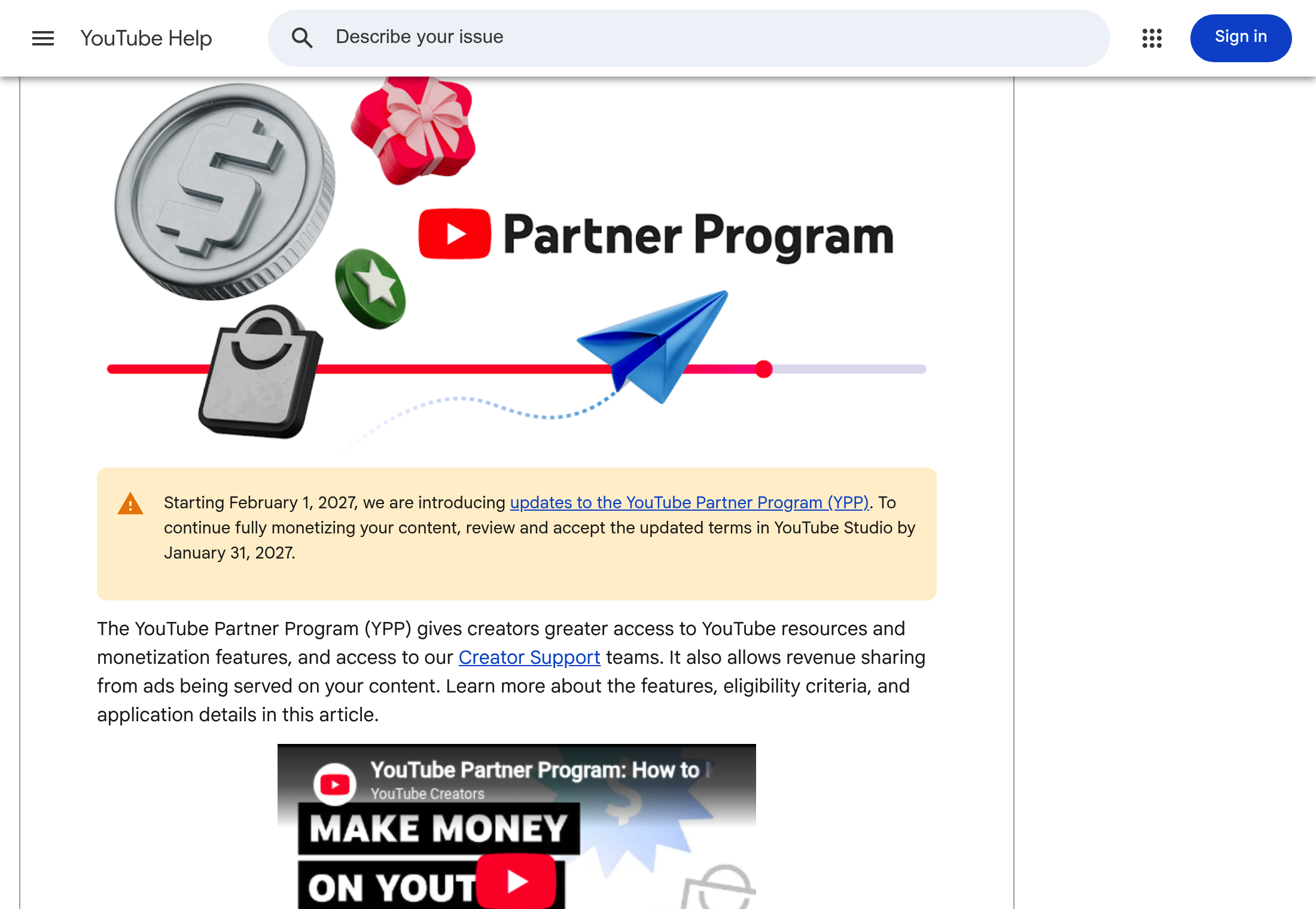
The banner sits at the top of the official eligibility page. The deadline to accept the new terms is 31 January 2027.
From 1 February 2027, the full Partner Program threshold becomes 8,000 qualified watch hours in the last 365 days, or 20 million qualified Shorts views. Double the current bar on both routes. Creators must review and accept the updated terms in YouTube Studio by 31 January 2027 to keep monetising fully.
That higher bar applies to new applicants: channels already in the program keep their place. What does apply to everyone is a new condition on Shorts: from the same date, a channel needs 10 million qualified Shorts views over the last 90 days to share in Shorts ad and subscription revenue. Both changes are detailed in YouTube monetization requirements.
The 500-subscriber entry door does not change. YouTube states that the thresholds for fan funding and shopping products remain as they are.
So the gap between the two doors widens considerably. If you are working toward monetisation today and reading a table that says 4,000 hours, that table has a four-month shelf life.
When you actually get paid
Two thresholds that almost no article mentions together:
$10 is the identity verification threshold. Before any payment, you verify your identity and address.
$100 is the payment threshold (€70, £60). Below it, your balance rolls over to the next month.
Payment goes out between the 21st and the 26th of the month, provided your balance reached the threshold at the end of the previous month. Reach it in January, get paid at the end of February.
Put the two together with the measured median RPM of $2.30 and a concrete picture appears: a channel at the all-niches median needs roughly 43,500 cumulative monetised views to trigger a first payment, and that payment arrives about a month after it qualifies. The threshold and the RPM are sourced; the multiplication is ours.
FAQ
How much do YouTubers make per 1,000 views?
There is no published rate. What exists is a measured median of $2.30 per 1,000 views across 300 monetised channels, ranging from $10.22 in education and science down to $0.33 in kids and teens. YouTube itself publishes only its revenue share, 55% of net ad revenue on long-form videos, and states there is no guarantee about how much you will be paid.
What is the average YouTuber salary?
No credible source publishes one, and an average would be misleading here anyway. A survey of 5,095 creators found 67% earning under $10,000 a year and just under 5% above $100,000. That distribution has no meaningful centre. The salary figures on job sites come from self-reported declarations, not measured channel revenue.
How many subscribers do you need to make money on YouTube?
Five hundred, for memberships, Super Chat, Super Thanks, gifts and shopping features, provided you also have 3 public uploads in 90 days and 3,000 watch hours. One thousand, plus 4,000 watch hours, for ad revenue. From 1 February 2027 that second threshold rises to 8,000 watch hours.
Do most YouTubers make money from ads?
Not the ones earning well. Among Partner Program channels that earned five figures or more in 2024, YouTube's own data shows more than 50% generated revenue from sources other than ads and Premium.
How much does YouTube take?
It depends on the product. YouTube keeps 45% of net ad revenue on long-form videos, 55% of the revenue allocated to a creator from the Shorts Creator Pool, and 30% on memberships and Supers. On iOS, App Store fees are deducted before the 70% is calculated.
Does using music in a Short reduce what you earn?
Your rate stays at 45% whether you use music or not. What changes is the pot: a Short with a music track contributes only half of its associated revenue to the Creator Pool, the other half covering licensing. Same percentage, smaller base.
Useful sources
- How YouTube revenue sharing works (YouTube Help), for the 55%, 45% and 70% shares and the "no guarantees" clause.
- YouTube Partner Program overview and eligibility (YouTube Help), for the 1,000-subscriber thresholds and the February 2027 change.
- YPP eligibility for fan funding and shopping (YouTube Help), for the 500-subscriber entry door.
- New opportunities to earn and changes to the YouTube Partner Program (YouTube Official Blog, 10 August 2026), for the 8,000 hours and 20 million Shorts views thresholds.
- The YouTube creator economy (YouTube), for the share of five-figure channels earning beyond ads, and the $32 billion paid in 2024.
- Shorts monetisation and the Creator Pool (YouTube Help), for how music affects the pool rather than the rate.
- AdSense payment threshold and payment schedule (AdSense Help), for the $10 verification and $100 payment thresholds and the 21st-to-26th window.
- How much do YouTubers with 1M subscribers make (AIR Media-Tech, updated 26 August 2026), for the measured RPM medians. Method: 300 channels, 3,595 channel-months, May 2025 to May 2026.
- State of Creators 2026 (CreatorIQ, 11 August 2026), for the earnings distribution. Method: 5,095 creators, 100 regions, ±1.4 points.
The honest answer to this question is a distribution, not a number, and the most actionable part of it is that the channels doing well are rarely doing well on ads alone.
That is also why we do not rank videos against a platform-wide benchmark. A video is measured against the median of its own channel, which is the only comparison that holds when RPMs vary by a factor of thirty between niches. If you want to see which formats break out before they reach your market, our country rankings apply that measurement market by market, and our revenue calculator runs on the measured RPM ranges rather than on advertiser CPMs.