
How much does YouTube pay for 1 million views? The payout, and how rare a million is
What a million views pays at the measured median, what the same million is worth by niche, and how often videos actually get there in our own tracking data.
Published September 29, 2026
The short version
- At the best measured median available, a million views is worth about $2,300 across all YouTube revenue sources. By niche it runs from roughly $330 to over $10,000 for the same million.
- Views do not pay. Monetized views pay, and only 53% of views carried an ad at the median of that dataset.
- A million is rarer than the search results suggest. Across the 118,209 long-form videos we track, 11.1% have passed a million. The median tracked video sits at 48,860 views.
- And our sample is tilted toward big channels (median channel: 2.9 million subscribers), so 11% is a ceiling, not a platform average.
- Half the channels we track have never had one. Of 1,615 channels with at least 20 tracked videos, 820 have crossed a million at least once, and only 234 do it on more than half their videos.
Every article on this question answers with a number and moves on. Two thousand dollars. Five thousand. Somewhere between three and five thousand, says the one that hedges.
The number is the easy half, and we have already taken it apart in how much YouTube pays per view: there is no per-view rate, only a revenue share applied to the ads that actually ran.
The half nobody publishes is the other one. How often does a video reach a million at all? That question has an answer in our own measurements, and it changes what the payout figure means.
The payout, in one table
The only dataset we have found with a published method is AIR Media-Tech's: 300 channels, 3,595 channel-months, May 2025 to May 2026. Its all-channel median total RPM was $2.30 per 1,000 views, all revenue sources included.
Applied to the milestones people actually search for:
| Views | At the $2.30 median | Education ($10.22) | Kids ($0.33) |
|---|---|---|---|
| 100,000 | $230 | $1,022 | $33 |
| 1,000,000 | $2,300 | $10,220 | $330 |
| 10,000,000 | $23,000 | $102,200 | $3,300 |
A factor of thirty separates the two ends of that table, for the same million views. The niche matters, the audience country matters more, and neither is something the view counter shows you.
Two things that table is not. It is not a promise: a median describes a middle, and half the measured channels sat below it. And it is not linear in the way people assume. RPM does not rise because a video did well. What rises with a bigger audience is what else you can sell, which we come back to at the end.
A million views is not a million paid views
This is the fact that invalidates most estimates you will read, and it is worth repeating in this context.
In that same dataset, only 53% of views carried an ad at the median. The rest were served to viewers with an ad blocker, to Premium subscribers, on videos with limited advertiser demand, or simply without a slot filled.
So the calculation everyone does, advertiser CPM multiplied by the 55% creator share, describes a world where every view carries an ad. It overstates earnings by roughly a factor of two. The whole mechanism is in the per-view article.
For Shorts, the gap is larger again: Shorts revenue comes from a pool allocated by views, of which creators receive 45%, and the measured outcome is an order of magnitude below long-form.
How often a video actually reaches a million
Here is what nobody else can tell you, because it needs measurement rather than an estimate. We track long-form videos across the channels that appear in our country and topic rankings, and we re-read their view counts on a schedule.
On 118,209 long-form videos, across 1,905 channels, in September 2026:
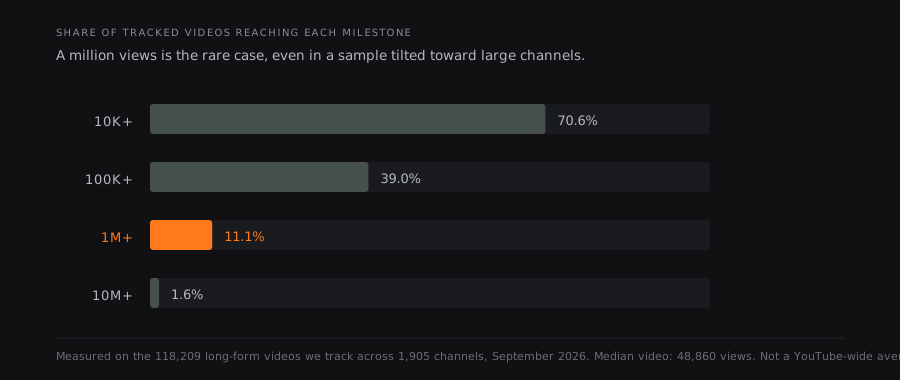
Each step removes most of what came before it. The median tracked video sits at 48,860 views.
- 70.6% have passed 10,000 views
- 39.0% have passed 100,000
- 11.1% have passed 1,000,000
- 1.6% have passed 10,000,000
Read that with its bias, which runs in one direction. Our base is not a random sample of YouTube. It is built from the channels that rank in 48 country markets and 33 topics, so it leans heavily toward large, established channels: the median tracked channel has 2.9 million subscribers. In a sample deliberately stacked in favour of big audiences, a video still has about one chance in nine of reaching a million. On YouTube as a whole, the real share is lower. We do not know how much lower, and neither does anyone publishing a percentage on this without a dataset.
Half the channels we track have never had one
Looking at it per channel rather than per video makes it clearer.
Of the 1,615 channels with at least 20 tracked videos:
- 820 (50.8%) have crossed a million at least once.
- Among those, the median channel gets there on 18.2% of its videos, so roughly one video in five.
- Only 234 channels (14.5%) clear a million on more than half their videos.
That is the shape of the thing. A million views is not a level you reach and then hold. Even for channels that have done it, it stays the exception, which is exactly why a single viral video is a terrible basis for a revenue forecast, and why we measure every video against the median of its own channel rather than against a platform benchmark.
One measurement we will not turn into a rule yet: among the videos we have tracked from their publication date, only 21 crossed a million within 30 days, and 14 of them were already past it at day 7. The direction is what you would expect, the sample is far too small to publish as a percentage. We will revisit it when the tracking window is longer.
What actually changes between tiers
Since the per-view payout barely moves with scale, the interesting question is what each tier unlocks.
Under 1,000 subscribers, view count is irrelevant to earnings. A million views on a channel outside the Partner Program pays zero: YouTube can still run ads on it, and the revenue share does not apply. The thresholds and the February 2027 changes are the gate, not the view counter.
From 500 subscribers, memberships, Supers and Shopping open. This is the tier where a small, engaged audience starts to beat a large, passive one.
From 1,000 subscribers and 4,000 watch hours, ad and Premium revenue apply, and the table above starts to mean something.
Past the first few hundred thousand views per video, the ad payout stops being the main line. YouTube's own 2024 data: among Partner Program channels earning five figures or more, over half made money from sources other than ads and Premium. We go through those sources in how much YouTubers make, and the most extreme example, how much MrBeast makes, shows ads as a small line even at 111 million views per video.
So the honest answer to what a million views is worth: about $2,300 in ad and Premium revenue at the median, and considerably more than that in what it lets you sell next, if you have something to sell.
Work out your own number
Your RPM is in YouTube Studio, under Analytics, Revenue. It is the only figure that describes your channel, and it is the number to put into any projection instead of a median measured on someone else's 300 channels.
Our revenue calculator runs on the measured RPM ranges rather than on advertiser CPMs, so it gives a range rather than a single reassuring figure. If you are still working toward the threshold, the watch hours calculator covers the half of it that people underestimate.
FAQ
How much does YouTube pay for 1 million views?
About $2,300 at the best measured median available, across all revenue sources, in a dataset of 300 channels and 3,595 channel-months. The realistic range for the same million runs from roughly $330 on a kids' channel to over $10,000 on an education channel. There is no fixed rate, because YouTube pays a share of the ads that actually ran, not a price per view.
Why do estimates for 1 million views vary so much?
Because three things move independently: the niche, which changes advertiser demand; the audience country, which changes it more; and the share of views that carried an ad at all, measured at 53% at the median. An estimate that ignores the third is roughly twice too high.
How many views does it take to make $1,000?
At the $2.30 median, about 435,000 views. On an education channel at $10.22, about 98,000. On a kids' channel at $0.33, about 3 million. Your own RPM in Studio replaces all three figures.
What percentage of YouTube videos get a million views?
Nobody publishes a reliable platform-wide figure, ourselves included. What we can say is measured: across the 118,209 long-form videos we track, which lean heavily toward large channels, 11.1% have passed a million. The share across all of YouTube is lower than that.
Is 1 million views on Shorts worth the same?
No. Shorts revenue comes from a pool allocated by views, of which creators receive 45%, and measured outcomes sit an order of magnitude below long-form. From 1 February 2027, sharing in Shorts revenue also requires 10 million qualified Shorts views over the last 90 days, for every partner.
Does a viral video change my RPM?
Not by itself. RPM depends on who watched, where, and whether an ad ran, not on how many people watched. A video that goes far outside your usual audience often has a lower RPM than your normal uploads, because the extra views come from cheaper markets or from feeds where fewer ads are served.
Useful sources
- How much do YouTubers with 1M subscribers make (AIR Media-Tech, updated 26 August 2026), for the measured RPM medians. Method: 300 channels, 3,595 channel-months, May 2025 to May 2026.
- How YouTube revenue sharing works (YouTube Help), for the 55% and 45% shares and the absence of any per-view rate.
- YouTube Partner Program overview and eligibility (YouTube Help), for the thresholds that gate any payout at all.
- The YouTube creator economy (YouTube), for the share of five-figure channels earning beyond ads.
- Our own measurements: 118,209 long-form videos across 1,905 channels, read in September 2026. A sample built from our country and topic rankings, so tilted toward large channels.
The view counter is the metric everyone watches and the one that decides the least. What a million views pays depends on who watched, and whether a video gets there at all depends on the format, not on the channel's size.
That second part is what VideoTrends measures: every video compared to the median of its own channel, so the format that breaks out is visible the day it does, on any public channel, in any market.