
YouTube ad revenue: how it is calculated, and the 8-minute wall in our data
How YouTube ad revenue is actually calculated, why your RPM sits far below CPM, what moves it through the year, and the 8-minute threshold visible in our data.
Published November 1, 2026
The short version
- YouTube pays creators 55% of the net revenue from ads on their long-form videos, and 45% of a pooled allocation on Shorts. There is no rate per view: the money depends on how many views carried an ad, how many ads each carried, and what advertisers paid for them.
- Only 53% of views carried an ad at the median of the largest published dataset of real Studio figures, and a monetised view carried 1.55 ads. Those two numbers explain most of the gap between the CPM quoted online and the RPM in your dashboard.
- Mid-roll ads need a video of 8 minutes or more. In our own tracking, there are 2.4 times more videos between 8:00 and 8:14 than between 7:45 and 7:59. Creators stretch their videos to the threshold, and it shows.
- The calendar moves the rate more than most niches do. Median RPM peaks in November ($2.35) and falls to $1.56 in January.
- Estimated revenue is adjusted twice after the month ends, so the figure you see on the 1st is not the one you get paid.
Most explanations of YouTube ad revenue stop at "advertisers pay, YouTube keeps 45%". That sentence is true and nearly useless, because the 45% is only one of the deductions between an advertiser's budget and your bank account, and often not the biggest.
This article follows the money through each step, with YouTube's own definitions, the largest published dataset of real Studio figures, and one thing nobody else can show you: what the 8-minute mid-roll rule does to the length of the videos people actually publish.
How YouTube ad revenue is calculated
YouTube's help centre states the share plainly. A partner who accepts the Watch Page Monetization Module receives 55% of net revenues from ads displayed or streamed on their public videos, including when those videos play in the YouTube player embedded on other sites. On Shorts, the partner receives 45% of the revenue allocated to them from the Creator Pool, based on their share of views.
What YouTube does not publish is a price. Its partner earnings page says it in so many words: there are no guarantees about how much, or whether, you will be paid. Your ad revenue is the product of four things, and only one of them is fixed:
- How many of your views carried an ad. YouTube calls these monetised playbacks.
- How many ads each of those views carried. One pre-roll, or a pre-roll plus three mid-rolls.
- What advertisers paid for each ad, which moves with the audience's country, the season and the format.
- Your share, 55% on long-form.
YouTube's own worked example shows how fast the first three shrink the result. A video is viewed 5,000 times. 1,000 views include one ad and 500 include two: that makes 1,500 monetised playbacks and 2,000 ad impressions. Advertisers pay $7 in total. The CPM is $3.50, the playback-based CPM $4.67.
Apply the 55% share to those $7 and the creator receives about $3.85 for 5,000 views: an RPM of roughly $0.77, against a CPM of $3.50. That last step is our arithmetic on YouTube's example, treating the $7 as net ad revenue, but its shape is the whole story: a decent CPM, most views carrying no ad, a modest RPM.
CPM, playback-based CPM, RPM: three numbers, three questions
YouTube Studio shows all three, and they answer different questions.
| Metric | What it measures | Before or after YouTube's share | Which views count |
|---|---|---|---|
| CPM | What advertisers paid per 1,000 ad impressions | Before | Only views that showed an ad |
| Playback-based CPM | What advertisers paid per 1,000 playbacks with at least one ad | Before | Only views that showed an ad |
| RPM | What you earned per 1,000 views, all YouTube revenue sources | After | All views |
RPM is the only one that describes your income. It includes ads, YouTube Premium, channel memberships, Super Chat and Super Stickers, and it counts every view, including the ones that never showed an ad. That is why YouTube answers "why is my RPM lower than my CPM?" with exactly those two reasons.
The figures quoted online are usually a fourth number that is not in your dashboard at all. AIR Media-Tech, which read the Studio data of 300 channels over 3,595 channel-months, calls it the advertiser CPM: the estimate published by third-party tools, roughly 1.5 to 2 times the CPM a channel actually sees in Studio. On tech channels, the chain runs like this: $9 to $11 estimated from the outside, $5.73 measured in Studio, $2.33 of RPM.
We took the per-view consequences apart in how much YouTube pays per view, and the spread between niches in the most profitable YouTube niches.
Why almost half your views pay nothing
Across those 300 channels, the median channel monetised 53% of its views. The spread by niche is wide: 77% on education, 55% on gaming and entertainment, 34% on tech, 32% on kids' content.
YouTube lists the reasons a view carries no ad:
- the video is not advertiser-friendly, or ads are turned off for it;
- no available ad matched the advertiser's targeting for that viewer;
- the viewer's country, how recently they saw an ad, or a YouTube Premium subscription.
Premium views are not lost money, since Premium revenue is shared too, but they never show an ad.
The second lever is ad load. The median monetised view in the AIR sample carried 1.55 ads: 1.84 on education, 1.29 on kids' content. And ad load depends, more than anything, on whether the video is long enough to carry ads in the middle.
The 8-minute wall
The rule fits in one line of YouTube's help: on monetised videos 8 minutes or longer, you can turn on ads during the video, known as mid-rolls. Under 8 minutes, YouTube still serves ads before and after the video automatically when appropriate, and on mobile a "Watch While" ad that sits beside the video without pausing it. But the mid-roll, the format that lets a single view carry several ads, starts at 8:00.
We wanted to know whether creators respond to that rule, so we counted. Among the long-form videos we track, grouped by length in 15-second steps:
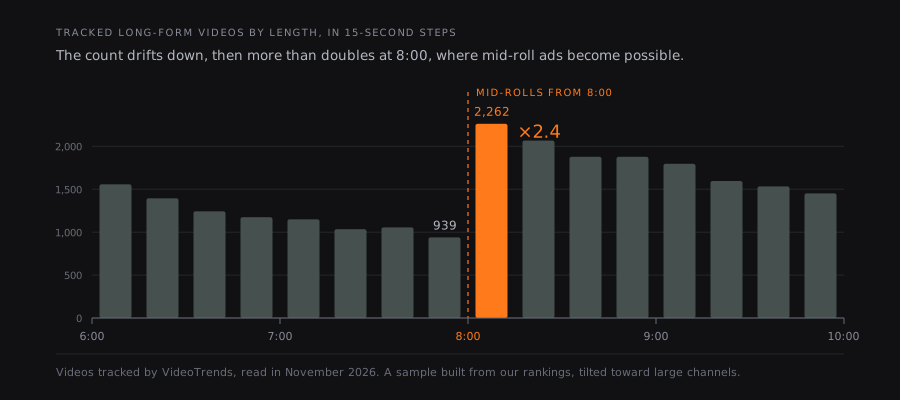
The count drifts down to 939 just before 8:00, then jumps to 2,262 in the 15 seconds that follow.
- 939 videos run between 7:45 and 7:59.
- 2,262 videos run between 8:00 and 8:14: 2.4 times as many, published by 417 different channels against 270.
- After the jump, the counts start declining again.
Nothing else changes at exactly 8:00. The most plausible reading is the obvious one: a large number of creators finish their edit, see 7:40 on the timeline, and find twenty more seconds.
Whether it pays is a separate question, and the honest answer is "not automatically". YouTube is explicit that an ad slot does not guarantee an ad: its systems weigh viewer experience, advertiser demand and the quality of the slot, and slots at natural breaks are more likely to serve than slots placed mid-sentence. AIR's reading of its own data goes the same way: a ten-minute video can hold several mid-rolls, an eight-minute video struggles to hold one. Twenty seconds of padding that make viewers leave before the break can cost more than the mid-roll brings in.
One more figure from our base, to read with its bias in mind (it is built from the channels in our country rankings and topic rankings, so it leans toward large channels): of the 172,506 videos longer than 3 minutes we track, 73.8% run 8 minutes or more.
November pays, January doesn't
CPM moves with the time of year, and YouTube says so itself: advertisers tend to bid higher just before the holidays. The AIR sample puts numbers on it. Median RPM, all niches pooled:
| Month | Median RPM | Month | Median RPM |
|---|---|---|---|
| January | $1.56 | July | $1.91 |
| February | $1.82 | August | $1.98 |
| March | $1.84 | September | $2.15 |
| April | $1.93 | October | $2.19 |
| May | $1.90 | November | $2.35 |
| June | $2.05 | December | $2.12 |
January sits 34% below November. The swing is very uneven by niche: AIR measured a fourth-quarter premium of about 60% for business and finance and 39% for food (both based on fewer than ten channels, so directional), against 11% for education and 4% for entertainment.
Two practical consequences. A creator in a high-swing niche gets more out of a strong upload in October than in January. And nobody should judge a channel's health on a January dashboard: the drop is structural and hits everyone at once.
Estimated is not final
The revenue in YouTube Analytics is an estimate, and YouTube adjusts it twice: about a week after the revenue is generated, then again when earnings are finalised in the middle of the following month. The adjustments come from invalid traffic, Content ID claims and disputes, and certain campaign types such as cost-per-day campaigns.
Finalised earnings are only visible in AdSense for YouTube, where they land between the 7th and the 12th of the following month. How that balance becomes a payment, with its five thresholds and the US tax form that can take 24% of everything, is the subject of how YouTube payouts work.
What you can actually move
YouTube's own advice to raise RPM is short: turn on monetisation for all your videos, turn on mid-roll ads, and add other revenue features such as memberships and Super Chat. The data adds three things.
- Channel size is not a lever. In the AIR sample, channels with 10,000 to 100,000 subscribers had a median RPM of $2.14, larger ones $2.04. Subscribers multiply your views, not the value of each one.
- Where you place mid-rolls matters as much as whether they exist. Slots at natural pauses are more likely to serve, and YouTube Studio flags in red the ones unlikely to.
- Ad money is concentrated. In the same sample, the top 10% of channels took 58% of all ad revenue and the bottom half shared 4%. The median creator's ad income is modest, which is why the channels that earn well usually sell something else too, as we showed in how much YouTubers make.
To put your own figures through it, our revenue calculator runs on measured RPM ranges rather than advertiser CPMs. If your channel is not in the Partner Program yet, the monetization checker shows how far you are from the thresholds. And what a million views is worth shows how rarely a video gets there at all.
FAQ
How is YouTube ad revenue calculated?
YouTube pays partners 55% of the net revenue from ads on their long-form videos, and 45% of the revenue allocated to them from the Shorts creator pool. There is no fixed rate per view: what you earn depends on how many views showed an ad, how many ads each carried, and what advertisers paid for them, which varies with the audience's country, the season and the format.
How much ad revenue does YouTube pay per 1,000 views?
The largest published dataset of real Studio figures, 300 channels over 3,595 channel-months, puts the median RPM at about $2.30 per 1,000 views, all YouTube revenue sources included. By niche, the median runs from $0.33 on kids' content to $10.22 on education. Your own RPM is in YouTube Studio, under Analytics, then Revenue.
What is the difference between CPM and RPM?
CPM is what advertisers paid per 1,000 ad impressions, before YouTube's share, counting only views that showed an ad. RPM is what you earned per 1,000 views, after YouTube's share, counting every view and every YouTube revenue source. RPM is always lower, and it is the one that describes your income.
How long does a video need to be for mid-roll ads?
8 minutes or longer. A mid-roll slot is not guaranteed to serve an ad: YouTube's systems weigh viewer experience, advertiser demand and the quality of the slot. Videos under 8 minutes can still show ads before and after the video, and on mobile a Watch While ad beside the video.
When is YouTube ad revenue highest?
In the fourth quarter. In the AIR Media-Tech sample, median RPM peaked in November at $2.35 and fell to $1.56 in January, 34% lower, as holiday advertising budgets ended. Business, finance and food channels swing the most, education and entertainment the least.
Why did my estimated ad revenue change after the month ended?
Because it is an estimate. YouTube adjusts it about a week after the revenue is generated and again when earnings are finalised the following month, for invalid traffic, Content ID claims and disputes, and certain campaign types. The finalised amount is the one posted to AdSense for YouTube between the 7th and the 12th.
Useful sources
- YouTube partner earnings overview (YouTube Help), for the 55%, 45% and 70% shares, the absence of any guarantee, and the two revenue adjustments.
- Understand ad revenue analytics (YouTube Help), for the definitions of RPM, CPM and playback-based CPM, the 5,000-view example and the reasons a view shows no ad.
- YouTube advertising formats (YouTube Help), for the formats, the 8-minute mid-roll rule and Watch While ads.
- Manage mid-roll ad breaks in long videos (YouTube Help), for manual and automatic slots, and the fact that a slot does not guarantee an ad.
- YouTube RPM in 2026: real data from 300 channels (AIR Media-Tech, updated 1 July 2026), for monetised-playback rates, ad load, monthly RPM, the fourth-quarter premium by niche and revenue concentration. Method: 300 channels, 3,595 channel-months, May 2025 to May 2026.
- Our own measurements: the length of the long-form videos we track, read in November 2026. A sample built from our country and topic rankings, tilted toward large channels.
An RPM is a ratio of ratios, and the rule that moves it most visibly is a stopwatch: 8:00. Everything else, the season, the audience's country, the share of views that ever see an ad, is invisible in a view counter.
VideoTrends measures the other half of the equation: which videos pull far more views than their own channel's median, so the formats worth making long enough to monetise are visible the day they break out.