
YouTube Shorts monetization: how the Creator Pool pays, and the 10 million rule of 2027
How Shorts revenue is pooled and split, what 1,000 Shorts views actually pay, what a Short earns next to a long video on the same channel, and the 2027 threshold.
Published November 8, 2026
The short version
- Shorts are not paid per view. Each month, the ads shown between Shorts are pooled, part of the pool covers music licensing, the rest is split between creators by their share of engaged views in each country, and the creator keeps 45% of their allocation.
- What that pays, measured: typically $0.07 to $0.20 per 1,000 Shorts views, 3% to 14% of long-form, and about $0.33 for a US audience. A million Shorts views is worth roughly $70 to $330.
- On the same channel, a Short gets about half the views of a long video, at the median of the 1,098 channels we track that publish both. At measured rates, that makes it worth 2% to 8% of a long video's revenue.
- From 1 February 2027, every partner needs 10 million qualified Shorts views over 90 days to share in Shorts revenue. Among the channels we track with 1 to 10 million subscribers, only 23% reached 10 million views on the Shorts they published in the last 90 days.
- The view counter is not the paid number. Since 24 August 2026, a view counts the moment a video starts playing. Earnings are still calculated on engaged views, which exclude loops and quick swipes.
Most articles on Shorts monetization stop at "creators get 45%". That number is real, and it is the last step of a four-step calculation in which most of the money has already gone somewhere else.
This article follows the calculation from YouTube's own policy page, puts measured rates on it, and adds two things only tracking data can show: what a Short earns next to a long video on the same channel, and how many channels would clear the 2027 threshold today.
How Shorts monetization works, in four steps
Long-form ads are sold against your video. A Short has no ad of its own: the ads run between Shorts in the feed, and nobody's Short "owns" them. So YouTube pools the money first and divides it afterwards. Its Shorts monetization policy describes four steps:
- Pool the Shorts feed ad revenue. Each month, the revenue from ads between Shorts is added together. It is used both to pay creators and to cover the cost of music licensing.
- Calculate the Creator Pool. A Short without music sends all of its revenue to the Creator Pool. A Short with one track sends half to the pool and half to music licensing; with two tracks, one third goes to the pool.
- Allocate the Creator Pool. The pool is divided between monetizing creators by their share of engaged Shorts views in each country. 5% of the eligible views means 5% of the pool.
- Apply the revenue share. The creator keeps 45% of their allocation, whether they used music or not.
YouTube works through a hypothetical example on the same page:
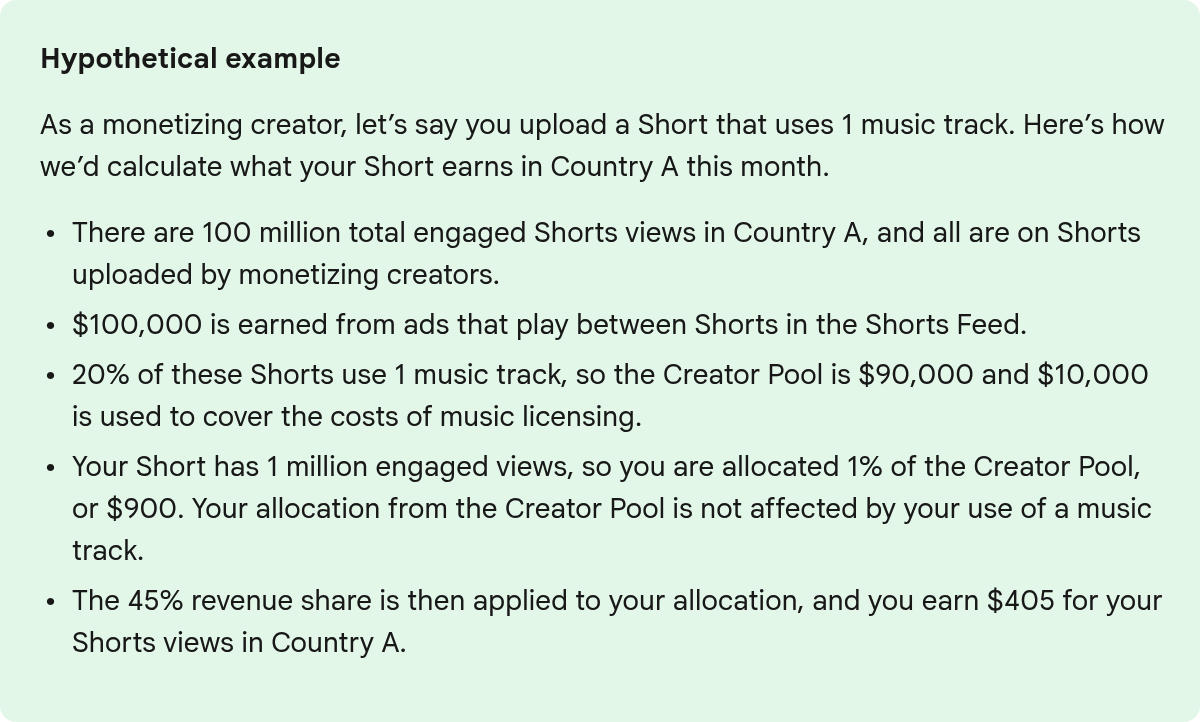
YouTube's own example ends at $405 for a million engaged views. It is a hypothetical: the measured rates below come in lower.
Two details in that example matter more than the final figure.
Music costs the pool, not you. Your allocation is based on your engaged views, "not affected by your use of a music track". Your music choice changes nothing for your own Short. What shrinks is the pool everyone shares: in the example, one Short in five used a track, and $10,000 of the $100,000 went to licensing before anyone was paid.
Some of the feed revenue never reaches the pool. YouTube lists what is excluded: revenue tied to views of Shorts from creators who are not monetizing (it covers music licensing or is retained by YouTube), Shorts uploaded by music partners, ads shown when the Shorts feed opens before any Short plays, ads on navigation pages in the Shorts player, and image posts in the feed.
YouTube Premium works the same way: YouTube pays 45% of the net Premium and Premium Lite revenue allocated to Shorts, divided by each creator's share of Premium subscribers' Shorts views in each country.
What Shorts actually pay
The only large published dataset of real Shorts revenue we know of comes from AIR Media-Tech: 274 channels that mix Shorts and long-form, 3,044 channel-months, read through the YouTube Analytics API.
| Shorts RPM | |
|---|---|
| Most niches | $0.07 to $0.20 per 1,000 views |
| As a share of the same niche's long-form RPM | 3% to 14% |
| US audience | $0.328 |
| UK, Canada, Germany | $0.16 to $0.17 |
| Music channels (Content ID) | 41% to 60% of long-form |
In practice, it takes 11,000 to 34,000 Shorts views to earn what 1,000 long-form views earn, in every niche except music. For most channels in the sample, Shorts brought in less than 2% of total revenue while accounting for up to 35% of views.
Music is the exception for a structural reason: channels that own the rights to the music in Shorts collect through Content ID, a revenue line no other niche can reach. Kids' content is a second, odder exception. On the few kids' channels AIR measured at video level (three per format, so a weak signal), 45.7% of Shorts views carried an ad, against 12.1% for long videos, because ad serving on long-form children's content is heavily restricted.
The long-form side of that comparison is in how much YouTube pays per view, and the mechanics behind long-form RPM (ad slots, mid-rolls, the seasons) are in YouTube ad revenue.
The view counter is not the paid number
This is where Shorts monetization is most often miscalculated, including by tools that estimate earnings from public view counts.
YouTube's help centre states that since 24 August 2026, views are counted the moment a video starts to play, across Shorts, long-form and live streams. The same page adds that this change does not affect Partner Program earnings or eligibility:
- earnings are still based on engaged views: viewers who stayed to watch past the first seconds, not counting loops;
- eligibility is still based on qualified views, which count only public Shorts shown in the Shorts feed.
So the number under a Short is now larger than the number YouTube pays on. Studio shows the gap directly in a metric called "Stayed to watch", the share of plays that turned into engaged views. Any estimate that multiplies the public counter by an RPM overstates the result, and the faster viewers swipe away, the bigger the error.
On top of that, some engaged views are not paid at all. YouTube excludes non-original Shorts (unedited clips of films or TV, re-uploads of other creators' content, compilations with nothing added), artificial views, views of content that is not advertiser-friendly, and blocked Shorts: a Short longer than one minute with an active Content ID claim of any kind is blocked worldwide and earns nothing.
What a Short earns next to a long video, on the same channel
Rates per 1,000 views compare formats in the abstract. The question a creator actually faces is narrower: on my channel, is the next Short worth what the next long video is worth? We can measure the views half of that on channels we track.
We took the 1,098 channels in our base that published at least five Shorts (up to 62 seconds) and five long videos (3 minutes or more) in the last 12 months, and compared, channel by channel, the median views of each format.
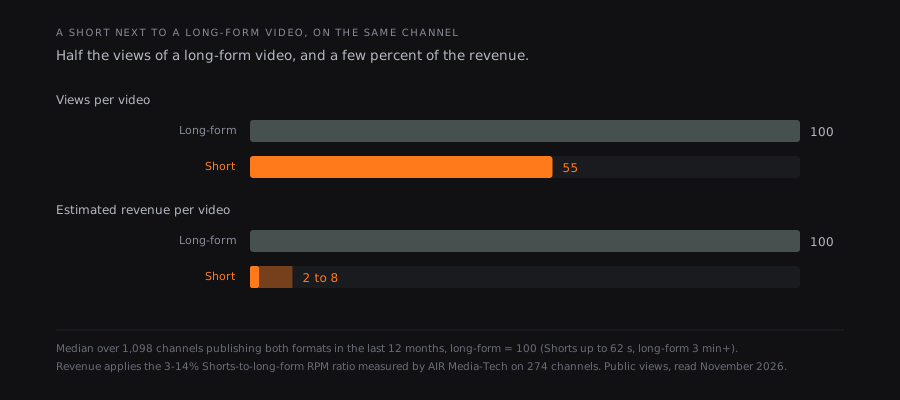
Half the views, and a few percent of the money. The revenue line applies AIR's measured 3% to 14% RPM ratio to our view counts.
- At the median, a Short gets 0.55 times the views of a long video on the same channel.
- The spread is wide: a quarter of channels sit below 0.20, a quarter above 1.27.
- On 31% of these channels (340), the median Short actually outdraws the median long video.
- Apply the measured RPM ratio, and the median Short earns roughly 2% to 8% of what a long video earns on its own channel.
Three cautions, all pointing the same way. These are public views, which count every start, so they overstate Shorts more than long videos. We count only Shorts up to 62 seconds, because our older Shorts flag predates three-minute Shorts. And our base leans toward large channels, built from our country rankings and topic rankings. None of these change the order of magnitude. Outside music and kids' content, a Short needs at least eleven times the views of a long video just to match its revenue, and only 36 of the 1,098 channels (3%) have Shorts that outdraw their long videos by that much.
The 10 million rule of 1 February 2027
This is the change that will cost money soonest. From 1 February 2027, YouTube's policy states that to earn a share of Shorts ad and Premium revenue for any month, a channel needs at least 10 million qualified Shorts views in the last 90 days. It applies to every partner, not only new applicants. We broke down the rest of the 2027 changes in YouTube monetization requirements.
The policy defines the window precisely: the 90 days ending on the 15th of the month before the month being paid. Read literally, Shorts revenue for February 2027 depends on qualified views between 18 October 2026 and 15 January 2027. If that reading is right, the window that decides the first month under the new rule is already open.
A channel below the bar stays in the Partner Program, keeps its long-form revenue, and gets Shorts revenue back automatically once it clears 10 million again.
How high is that bar? Among the channels we track that published at least one Short in the last 90 days, we added up the public views on those Shorts:
| Channel size | Channels | Reached 10 million views | Share |
|---|---|---|---|
| Under 100,000 subscribers | 102 | 2 | 2.0% |
| 100,000 to 1 million | 252 | 20 | 7.9% |
| 1 to 10 million | 644 | 148 | 23.0% |
| Over 10 million | 415 | 233 | 56.1% |
| All | 1,413 | 403 | 28.5% |
Even among channels with over 10 million subscribers, almost half fall short. Read it as a rough measure, not a forecast: we count views on Shorts published in the window, not every view the channel's Shorts received during it, and only Shorts up to 62 seconds, which understates; but public views include quick swipes that qualified views exclude, which overstates. What it does show is the scale. For most creators who make Shorts, the 2027 rule does not shrink Shorts revenue, it ends it.
The same date brings one new source of Shorts income: Shorts ads targeted to small groups of five channels or fewer will pay the creators directly, 45% of the net revenue from the specific ad, on top of the Creator Pool. YouTube has not said how often that will happen.
So are Shorts worth making?
As a revenue line, rarely, and less so after February 2027. As a way to reach people, the evidence is more mixed than either camp admits.
AIR's within-channel comparison, the same channels in months with and without Shorts, found entertainment channels at $4.58 RPM in months without Shorts and $1.84 in months with them, while gaming channels barely moved ($3.42 against $3.29). AIR itself says the causality is unproven: a channel may post Shorts in months when it is less active overall.
What that leaves is a judgment you can measure on your own channel. If your Shorts bring people who go on to watch your long videos, they are worth the time whatever they pay directly. If they mostly bring Shorts viewers who stay Shorts viewers, they cost production time for a few percent of the money. Comparing each video with the median of its own channel, as we describe in our growth strategy guide, is how you tell the two apart.
To check where your channel stands against the thresholds, the monetization checker reads its public numbers. The revenue calculator handles long-form and Shorts separately, with the measured ranges rather than a single reassuring rate. And for the most extreme case of the views-versus-money gap, see how much MrBeast makes: nine billion Shorts views in six months, and less ad money than his long videos.
FAQ
How much do YouTube Shorts pay per 1,000 views?
Typically $0.07 to $0.20 per 1,000 views, or 3% to 14% of the same niche's long-form RPM, measured on 274 channels by AIR Media-Tech. A mostly US audience brings it to about $0.33. Music channels that own the rights to their tracks earn more, 41% to 60% of their long-form rate, through Content ID.
How does YouTube Shorts monetization work?
The ads shown between Shorts are pooled each month. Part of the pool covers music licensing, depending on how many tracks Shorts use. The rest, the Creator Pool, is divided between monetizing creators by their share of engaged Shorts views in each country, and each creator keeps 45% of their allocation.
How many views do you need to monetize Shorts?
To join the Partner Program through Shorts, 1,000 subscribers and 10 million qualified Shorts views in 90 days today, 20 million for new applicants from 1 February 2027. From the same date, every partner also needs 10 million qualified Shorts views over the last 90 days to share in Shorts revenue each month.
Does using music in a Short reduce my earnings?
Not directly. Your allocation from the Creator Pool is based on your engaged views and does not change with music. Music reduces the size of the pool itself, because the revenue tied to Shorts with tracks is split with music licensing before the pool is divided.
Do Shorts views count toward watch hours?
No. Watch time from Shorts viewed in the Shorts feed does not count toward the watch hours threshold. The two routes into the Partner Program are separate and never add up.
Will I lose my Shorts revenue in 2027?
Only if your channel has fewer than 10 million qualified Shorts views over the 90 days ending on the 15th of the previous month. You stay in the Partner Program, keep your long-form revenue, and Shorts revenue resumes automatically once you are back above the threshold.
Useful sources
- YouTube Shorts monetization policies (YouTube Help), for the four steps, the music split, the exclusions, the hypothetical example, the 2027 threshold and its 90-day window, targeted Shorts ads and Premium revenue.
- New opportunities to earn and changes to the YouTube Partner Program (YouTube Official Blog, 10 August 2026), for what happens to a channel below the 2027 Shorts threshold.
- Understand your YouTube content performance (YouTube Help), for the change in view counting from 24 August 2026 and the definitions of engaged and qualified views.
- Understand three-minute YouTube Shorts (YouTube Help), for blocked Shorts over one minute with a Content ID claim.
- YouTube partner earnings overview (YouTube Help), for the 45% Shorts share.
- YouTube Shorts RPM vs long-form (AIR Media-Tech, updated 16 September 2026), for Shorts RPM by niche and country, the views needed to match long-form, and the within-channel comparison. Method: 274 channels, 3,044 channel-months.
- Our own measurements: 1,098 channels publishing both formats in the last 12 months, and 1,413 channels with Shorts published in the last 90 days, read in November 2026. A sample built from our rankings, tilted toward large channels.
A Short is a different product sold in a different place: one ad between swipes, shared by everyone in the feed. That is why the same view is worth a few percent of a long-form view, and why the 2027 threshold matters more than the 45%.
What does not change is the question worth asking about each video. VideoTrends compares every video, Short or long, to the median of its own channel, so you can see which formats pull far beyond the usual, and whether the people they bring stay.